

This guide covers six types of roaches in Houston and the rest of Texas, and which one you have decides what to do next. The chart sorts them from outdoor visitors to indoor residents, and each species below has a drawing, the details that give it away, and what to do.
Quick answer
Texas A&M AgriLife names the American, German, oriental and smokybrown cockroaches as the most common in Texas. The big ones, American and smokybrown, live mostly outdoors and come in for food or water. The small German cockroach lives only indoors, in kitchens and bathrooms, and Texas A&M calls it the most prolific indoor roach.
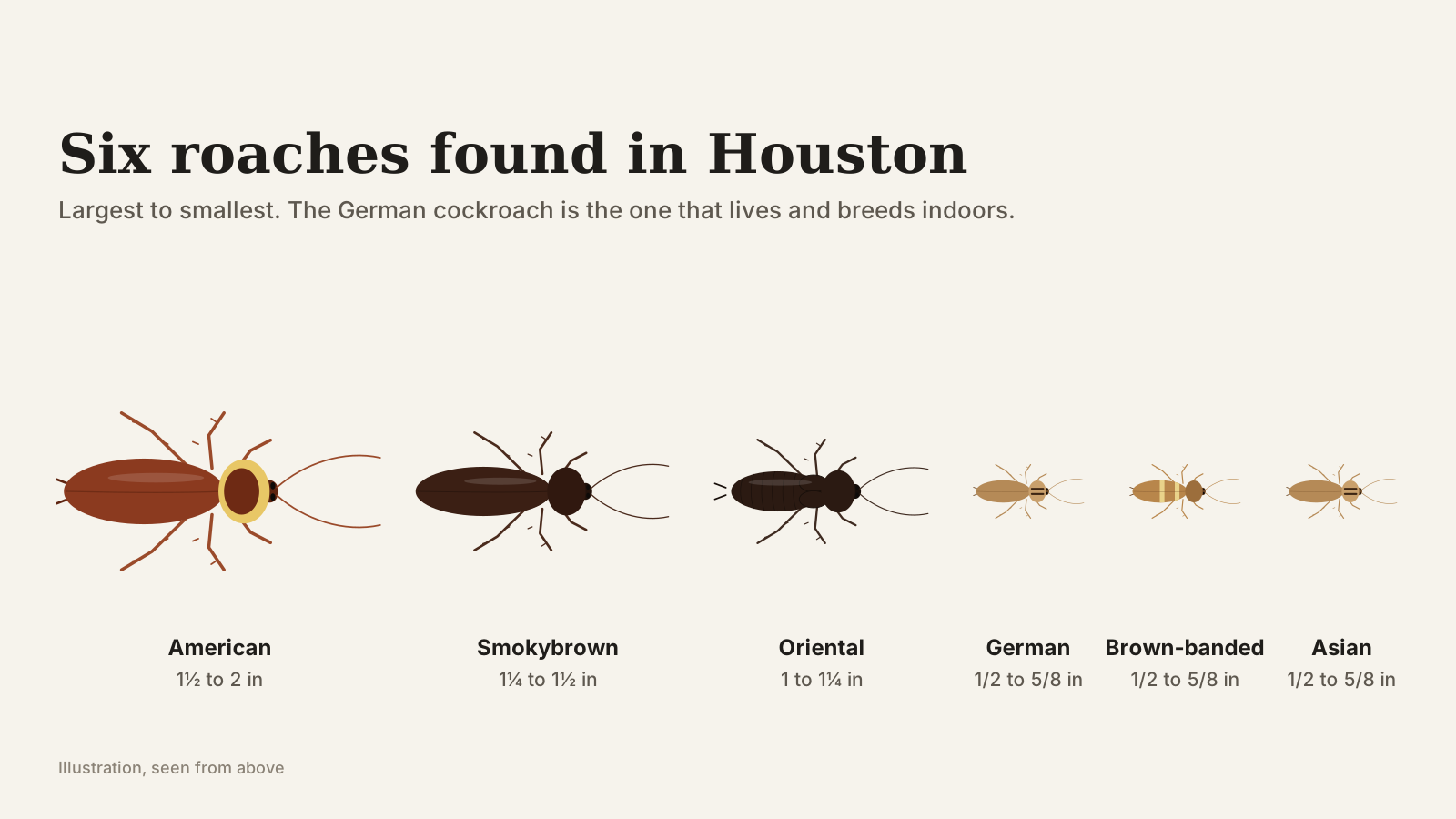
Houston roaches, from outdoor visitors to indoor residents
Outdoors, flies to lights
- Asian cockroach
Outdoors, comes in for food or water
- American cockroach
- Smokybrown cockroach
- Oriental cockroach
Indoors, in dry rooms and furniture
- Brown-banded cockroach
Indoors, in kitchens and bathrooms
- German cockroach
A rough guide drawn from the descriptions below. Texas A&M notes that seeing any cockroach out during the day usually means there are a lot of them.
What are you seeing?
- A big reddish-brown roach with a pale band behind the head
- An American cockroach. It often comes up drain pipes into kitchens and bathrooms.
- A big roach that is one solid dark color, near a porch light or in the attic
- A smokybrown cockroach.
- A slow, shiny black roach in a damp spot at ground level
- An oriental cockroach. The females can't fly and have only short wing pads.
- Small light-brown roaches with two dark stripes behind the head, in kitchen or bathroom cabinets
- German cockroaches, the ones that live and breed indoors.
- Small striped roaches flying in toward lit windows and doors at dusk
- Asian cockroaches. They look like German cockroaches but live outside and fly to light.
- Small roaches with pale bands across the body, in bedrooms, closets or furniture
- Brown-banded cockroaches.
Dealing with this right now?
Big roaches coming in, or small ones in the kitchen? Life After Bugs will identify them and treat where they hide, across Houston and Katy.
Learn more about our roach extermination in Houston & Katy.
The six roaches, one by one
American cockroach
Comes in from outside
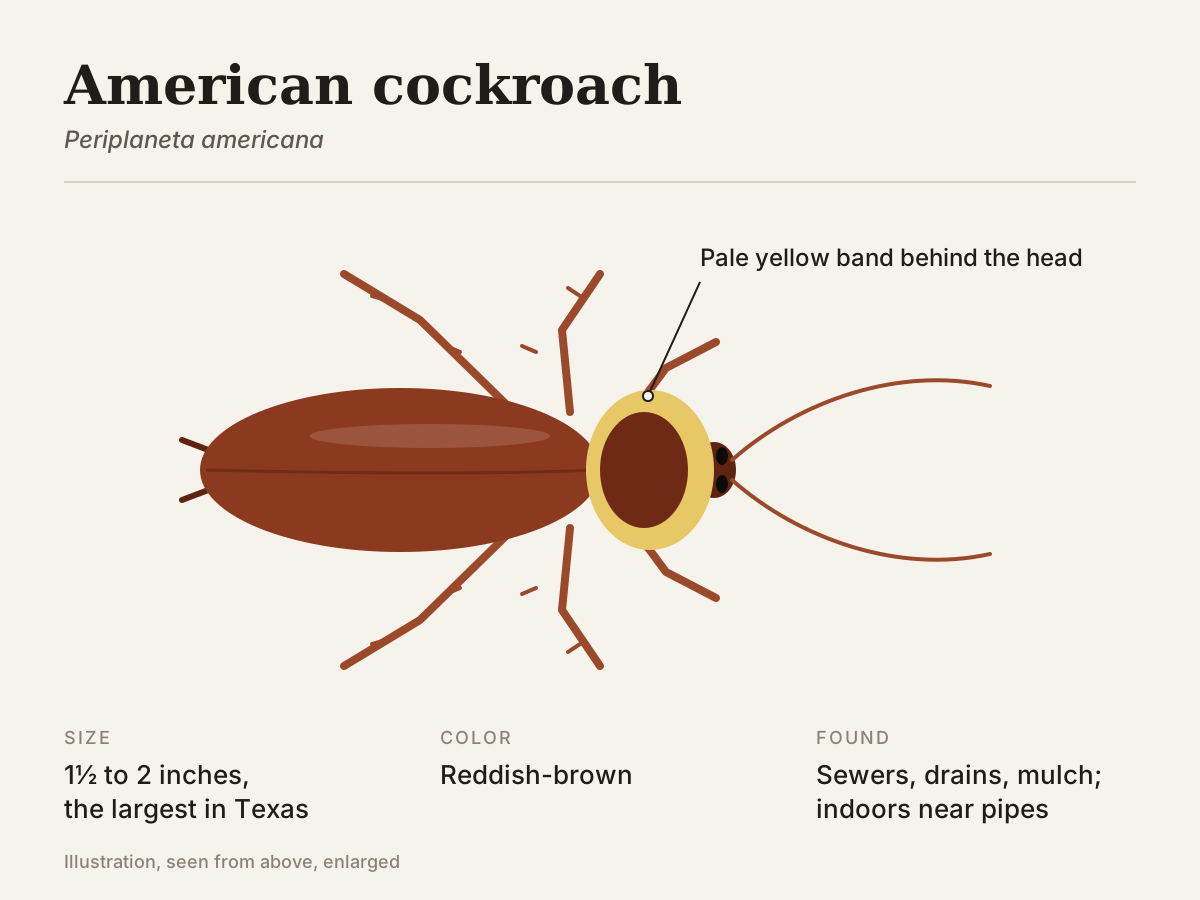
Texas A&M calls the American cockroach the largest cockroach in Texas and one of the most common. Adults are 1 1/2 to 2 inches long and reddish-brown, with a pale yellow band around the edge of the shield behind the head. The University of Florida notes it is often called a palmetto bug.
It likes humid places. Outdoors it lives under tree bark and in leaf litter, and it is one of the most common roaches in sewer systems, where it can travel up drain pipes into kitchens and bathrooms. Indoors it settles near furnaces, heating ducts and pipes. Adults have full wings and can fly, but Texas A&M's urban entomology program says they seldom do and describes their flight as gliding.
What to do: Keep water in little-used drains so the trap stays full, seal gaps around pipes and under exterior doors, and clear leaf litter and other damp debris away from the house. If they keep coming up the drains or out of the walls, see our cockroach control.
German cockroach
Lives and breeds indoors
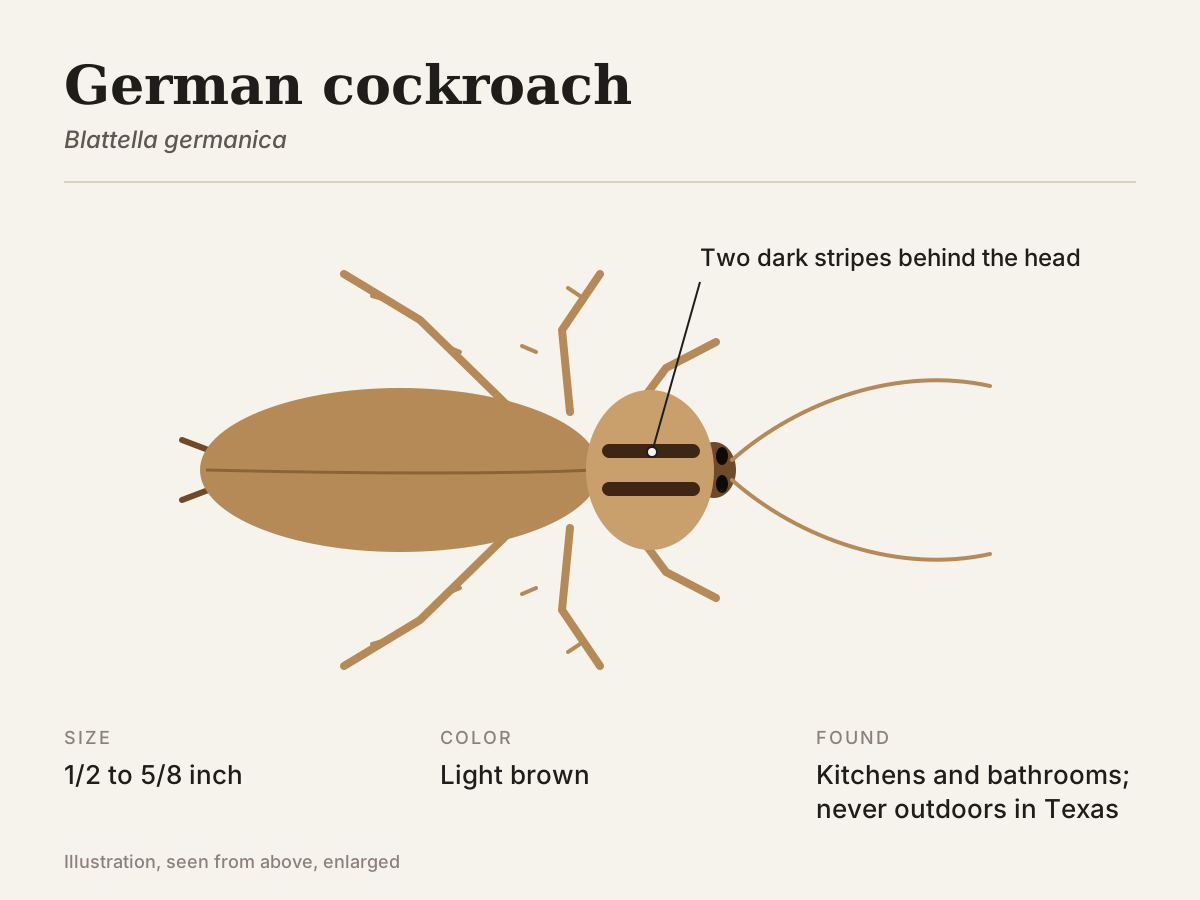
This is the small roach in kitchen and bathroom cabinets. Adults are 1/2 to 5/8 inch long and light brown, with two dark stripes running lengthwise on the shield behind the head. They have full wings but rarely fly.
Texas A&M says German cockroaches do not live outdoors in Texas. They come in on groceries and in boxes, spread between apartments, and spend about three quarters of their lives in narrow cracks close to food and water. The female carries her egg case until it is ready to hatch, and the young can reach adulthood in about 50 to 60 days at normal indoor temperatures. Texas A&M calls them the most prolific indoor roach.
What to do: Skip the bug bombs: Texas A&M notes they usually don't reach the cracks where these roaches hide. Put away food and water at night, including pet bowls, fix leaks, and seal gaps around sinks and plumbing. Texas A&M counts baits among the most effective indoor options, placed within a foot or two of where the roaches hide. An established infestation is usually a job for professional roach treatment, and there is more on apartments in our guide to German cockroaches in Houston apartments.
Roaches in the house?
Life After Bugs treats roaches across Houston and Katy. Tell us what you're seeing, and a technician will identify the species and treat where they hide.
Smokybrown cockroach
Comes in from outside
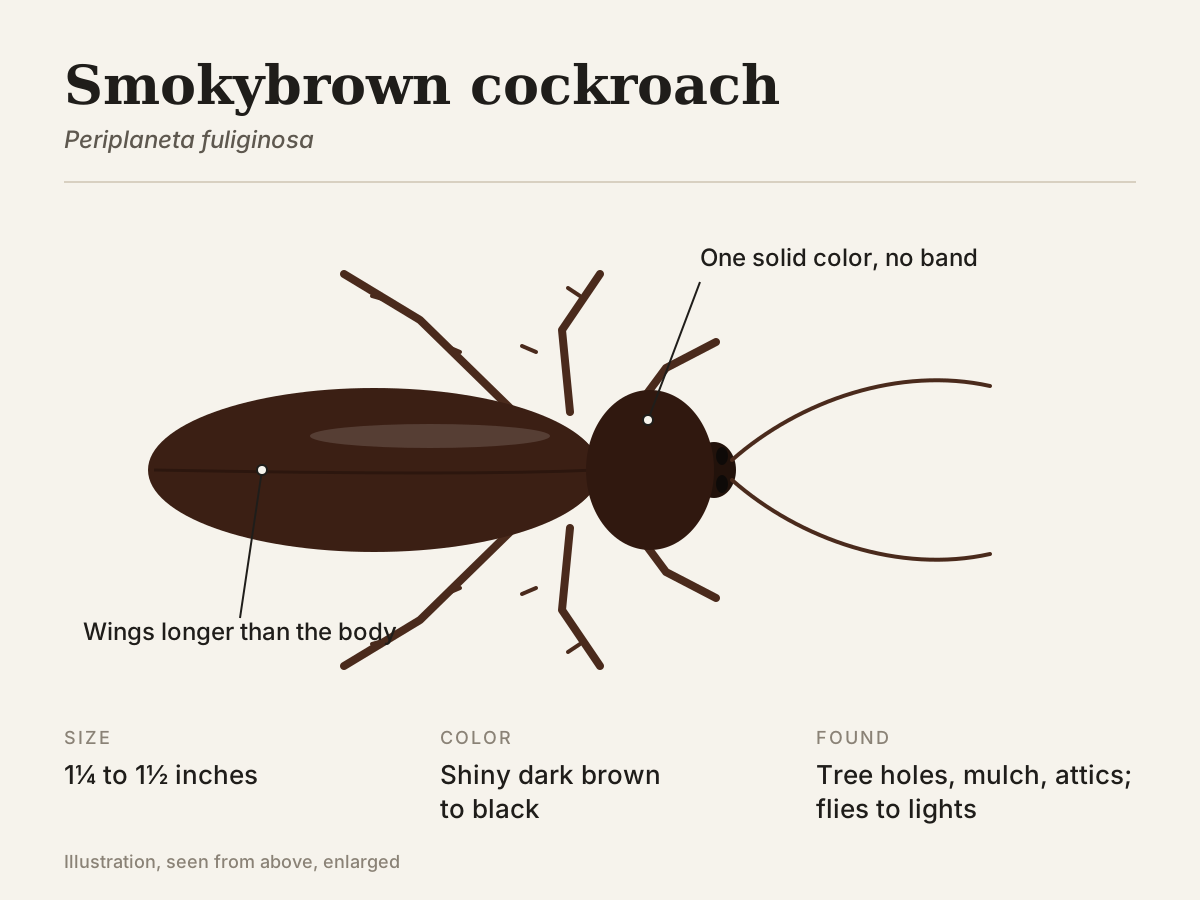
Texas A&M says the smokybrown cockroach is common outdoors, especially in the more humid parts of Texas. Adults are 1 1/4 to 1 1/2 inches long and one solid, shiny color, mahogany brown to black, with no pale band behind the head. The wings reach past the tip of the body, and the antennae are at least as long as the body.
It needs moist, warm, sheltered spots out of moving air: mulch, tree holes, palm fronds, woodpiles, soffits and the eaves of the attic. It is a good flier, it is drawn to light and comes in through lit openings, usually at night, and once inside it tends to end up in the attic or near a fireplace. A leaky roof can draw it in. The youngest nymphs look different from the adults: they are black, with two white bands and white-tipped antennae.
What to do: Fix roof and gutter leaks, stack firewood and lumber away from the house, and thin out damp, decaying debris near the foundation. Texas A&M's school pest plan suggests yellow or sodium-vapor bulbs for outdoor lights, set away from doors. If they are living in the attic or eaves, our roach control can treat them there.
Oriental cockroach
Damp spots at ground level
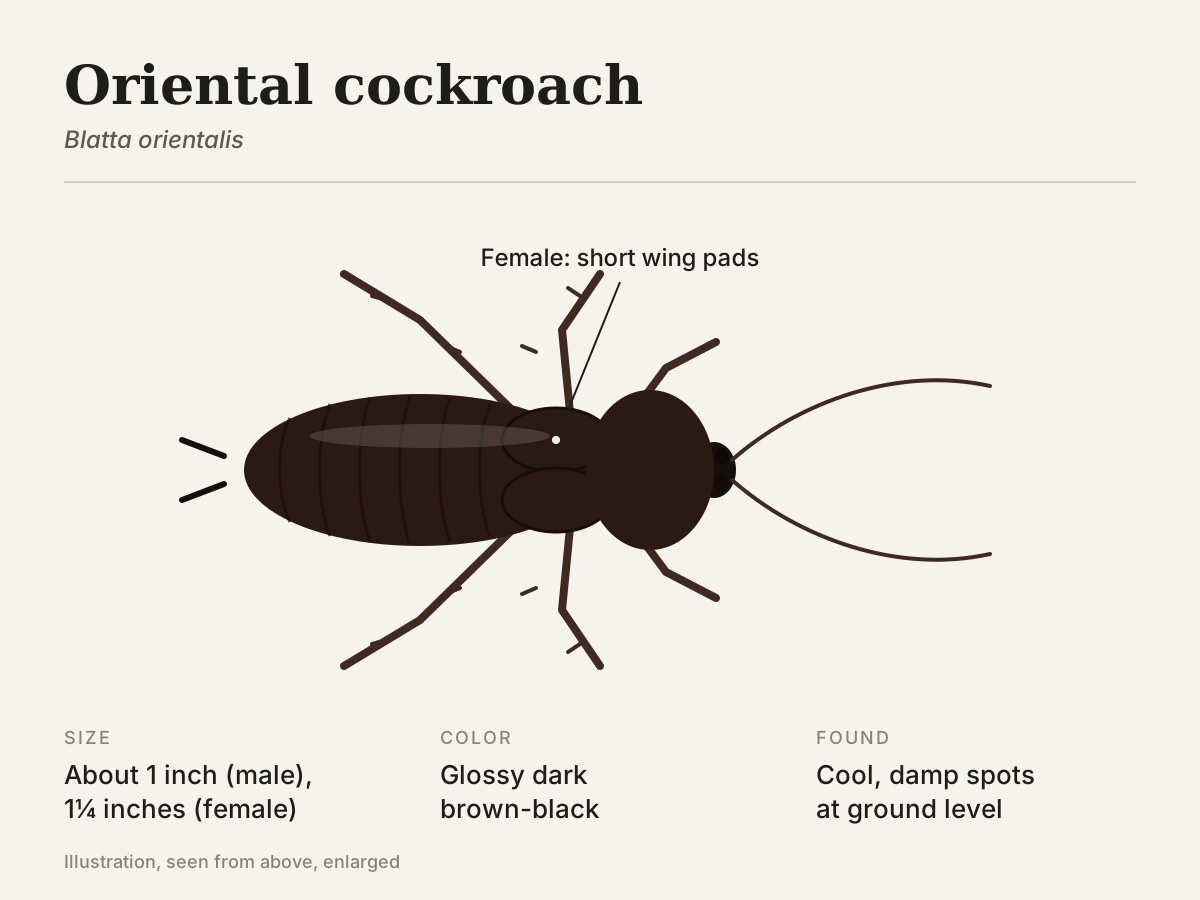
Texas A&M lists the oriental cockroach among the four most common cockroaches in Texas. It is glossy dark brown to black. Males are about 1 inch long, with wings that cover most of the body. Females are nearly 1 1/4 inches long, and their wings are only short pads. Neither one can fly.
It is slow, even when disturbed, and can't climb slick surfaces. Outdoors it lives in cool, damp places: under leaves, under porches and in compost. It gets in through cracks in the foundation, along sewer pipes and under doors, and inside it stays low, under refrigerators, sinks and washing machines and in crawl spaces and other wet spots at ground level. Texas A&M notes that more adults turn up in late spring and early fall.
What to do: Dry out damp spots and fix leaks under sinks and appliances. Seal foundation cracks and the gaps where pipes come in, and close the space under exterior doors. Our exclusion service seals the openings they use.
Brown-banded cockroach
Lives indoors, away from the kitchen
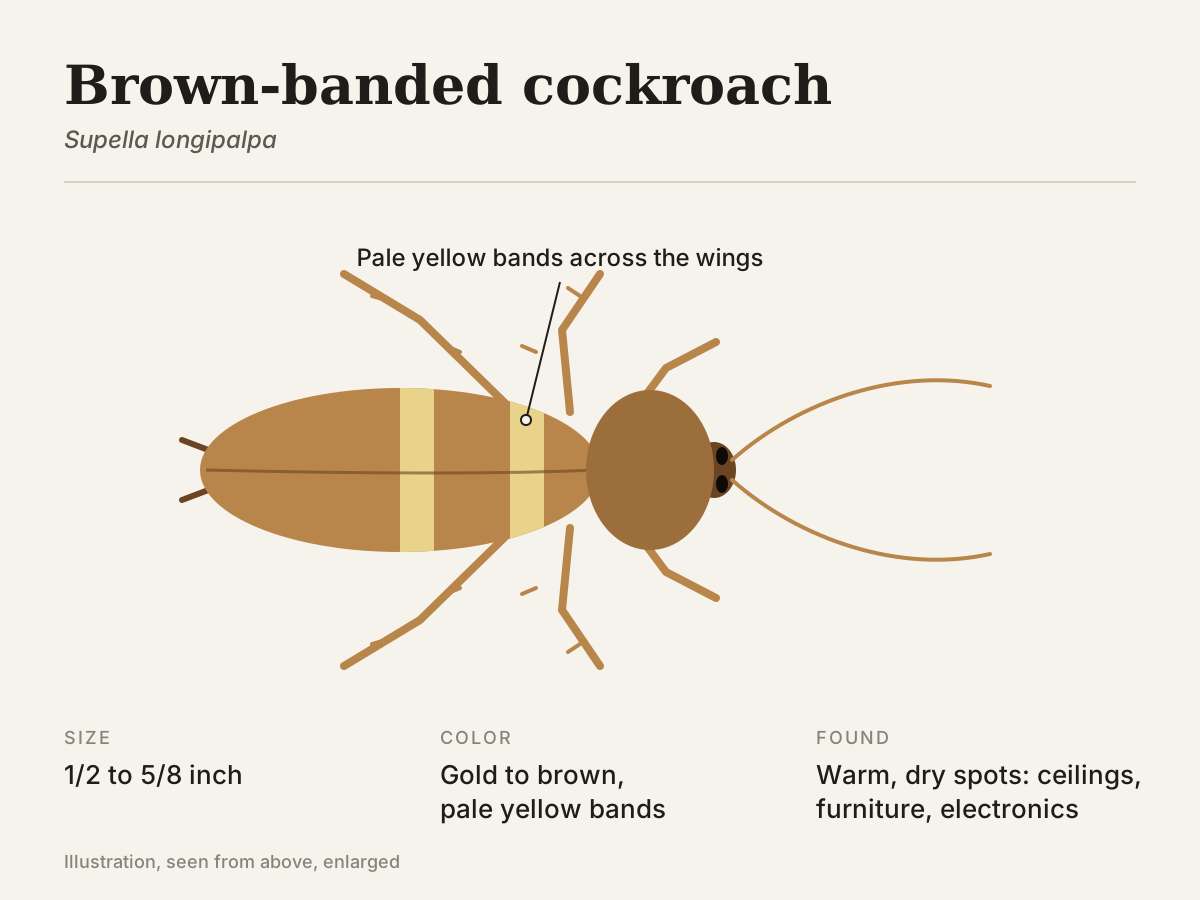
About the size of a German cockroach, 1/2 to 5/8 inch, but with pale yellowish bands across the wings and abdomen instead of two stripes behind the head. The color runs from light gold to glossy dark brown. Males have wings that cover the abdomen and can fly; females have wings shorter than the body.
LSU AgCenter says it is well distributed across the southern U.S. It appears to need less water than other roaches and lives in drier, warmer spots, so you find it away from the kitchen: high on walls and ceilings in dim rooms, behind picture frames, in light switches, high in cabinets and closets, inside upholstered furniture, and in the warm motors of appliances and electronics. LSU calls it the furniture roach. Females carry their purse-shaped egg cases for a while and then attach them to surfaces.
What to do: Check the whole house, not only the kitchen: behind frames, under and inside furniture, and up high in cabinets and closets. Look over used furniture and boxes before bringing them in. Because they scatter through a building, they are usually a job for roach treatment.
Asian cockroach
Lives outside, flies to lights
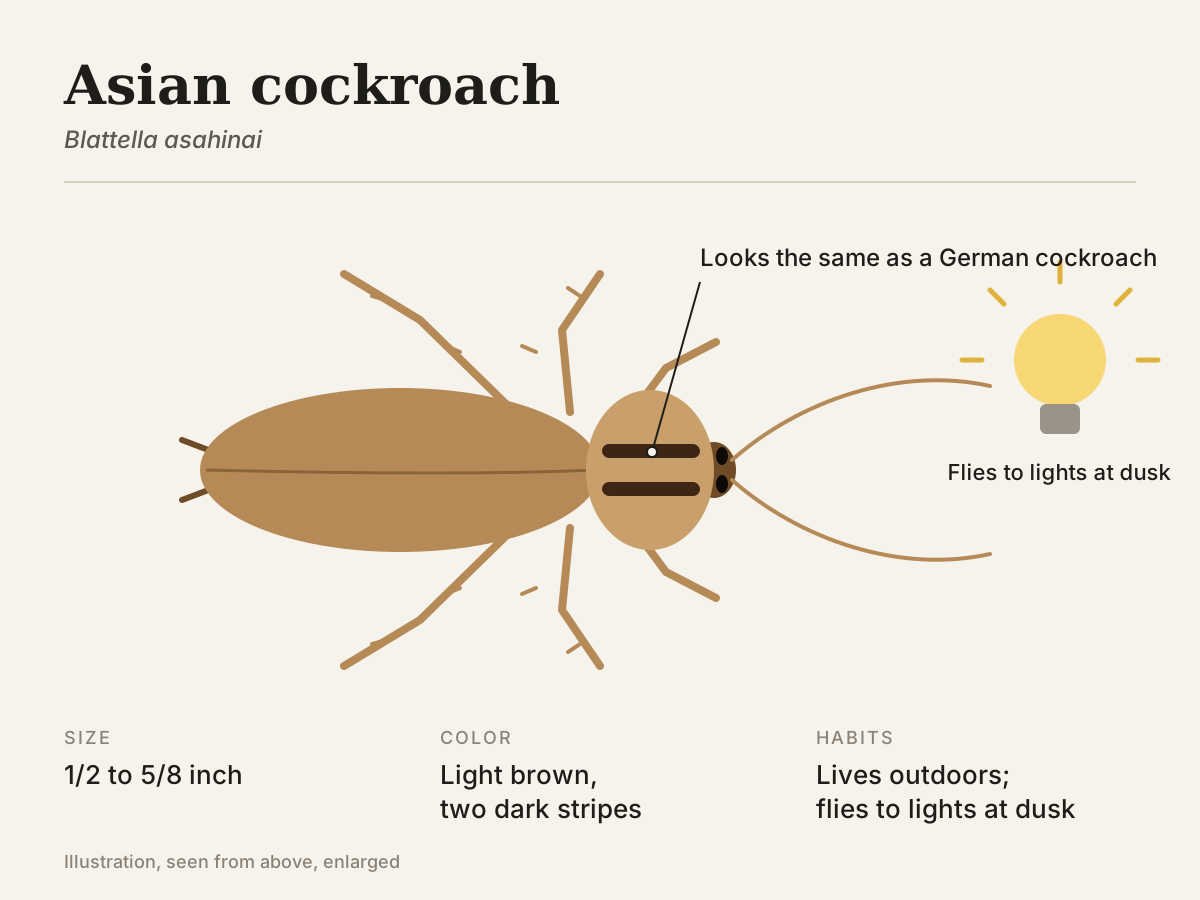
The Asian cockroach looks almost exactly like a German cockroach: 1/2 to 5/8 inch long, with the same two dark stripes on the shield behind the head. Texas A&M says that for practical purposes the two are identical in appearance, and that Asian cockroaches can be found outdoors in some areas of Texas.
The difference is where it lives and how it moves. It lives outside, in lawns, leaf litter and grassy areas, and it is a strong flier. Texas A&M says it becomes very active at dusk and is drawn to light reflected off light-colored walls, doors and windows, and the ones that get inside follow the lights from room to room. The University of Florida notes that thousands can gather on porches and windows at certain times of year, and that homeowners often run into them after mulching flower beds in spring.
What to do: If small striped roaches fly in from outside toward the lights, think Asian before German. Switch outdoor lights to yellow bulbs or turn them off, and keep door seals tight. Texas A&M notes that insecticide applied indoors has not controlled them, so the work is in the yard; our roach control treats where they live.
Big roach or small roach: why it matters
The first question is whether the roach lives in your house or only got in. Texas A&M says American, oriental and smokybrown cockroaches live mostly outdoors and come inside looking for food or water. German cockroaches spend their lives indoors, and brown-banded cockroaches are found mostly in homes, apartments and hotels. So a big roach in the bathroom is often a visitor, while small roaches in the kitchen cabinets point to a population living in the house. There is more on the big ones in why roaches come inside when it rains.
Most roaches hide by day and come out at night. Texas A&M notes that seeing cockroaches during the day usually means a large population, and suggests sticky traps to find where they travel. Traps are good for finding roaches, but they don't control an established infestation.
Keeping roaches out of a Houston home
Texas A&M's advice starts with taking away what roaches need. Cut down clutter, put away food and standing water at night, including pet bowls, fix leaks, and seal the gaps around sinks, plumbing and splash guards.
Outside, clear moist, decaying debris away from the house, keep sink and floor drain traps full of water, check the seals on exterior doors, and screen the soffits. Texas A&M also notes that bug bombs usually don't reach the cracks where roaches hide.
When to call for help
Call if you see roaches in daylight, small roaches in more than one room, or big roaches coming up the drains again and again. Contact us or call (832) 464-5870, and a technician will identify the species and treat where they hide. We treat roaches in Houston and roaches in Katy.
Related
Sources
- Texas A&M AgriLife Extension: Cockroach Biology and Management (ENTO-PU-121, Brown, Merchant and Siders, 2017)
- Texas A&M Urban and Structural Entomology: American cockroach
- Texas A&M Urban and Structural Entomology: German cockroach
- Texas A&M Urban and Structural Entomology: Smoky brown cockroach
- Texas A&M Urban and Structural Entomology: Oriental cockroach
- Texas A&M Urban and Structural Entomology: Brown-banded cockroach
- Texas A&M Urban and Structural Entomology: Asian cockroach
- Texas A&M AgriLife School IPM: IPM Action Plan for Outdoor Cockroaches
- University of Florida IFAS: American cockroach
- University of Florida IFAS: Smokybrown cockroach
- University of Florida IFAS: Asian cockroach
- LSU AgCenter: Brown-banded cockroach (Aaron Ashbrook)